M.Sc. Organismic Biology, Evolutionary Biology and Palaeobiology (OEP-Biology)
The M.Sc. in Organismic Biology, Evolutionary Biology and Palaeobiology is a two-year research-oriented, international study program taught in English aiming at providing students with a broad understanding of all aspects of Organismic Biology. Evolutionary Biology and Biodiversity Research connect various disciplines such as Systematics, Phylogeny, Palaeobiology, Physiology, Ecology, Molecular Biology, Ethology and many more. Strong emphasis is given to practical research experience in the field, in the laboratories of the participating research groups and in the large collections of the Zoological Museum Alexander Koenig, the Goldfuß-Museum of Palaeontology and the Botanical gardens of the University of Bonn. Teaching in OEP-Biology is theory-oriented aiming at enabling students to think critically, analytically and strategically.
Program Structure
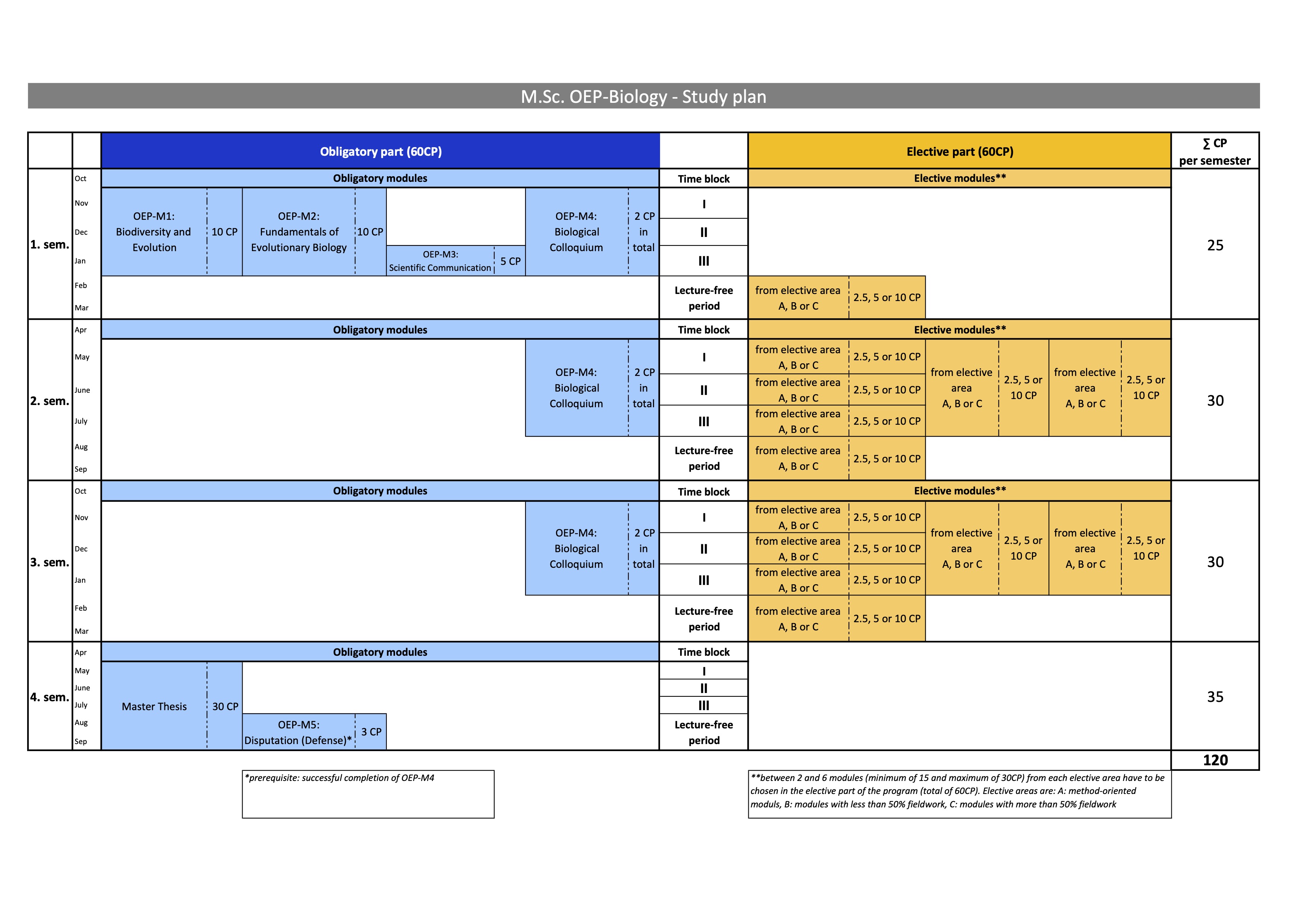
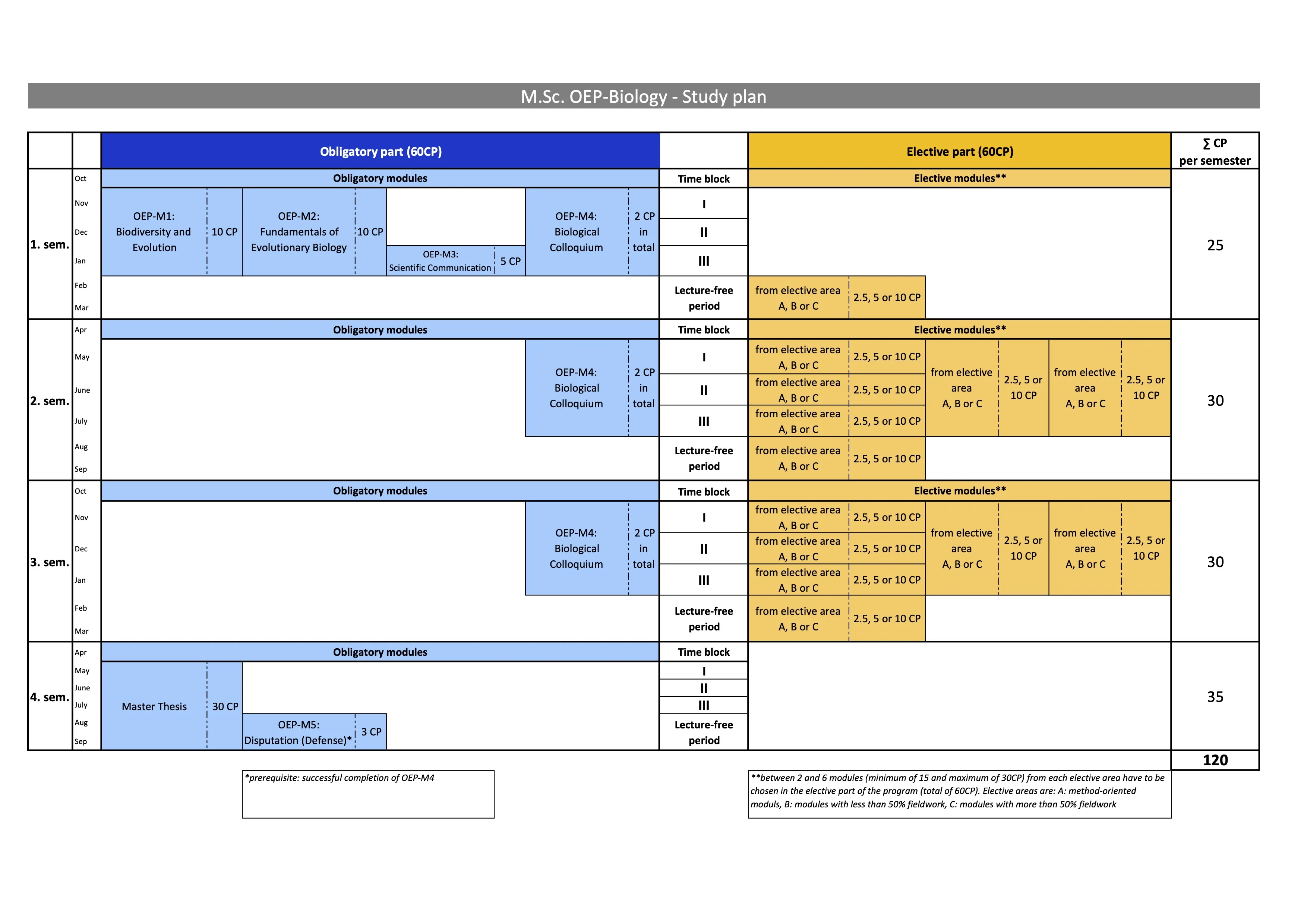
The M.Sc. OEP-Biology course program is consequently modularized according to the ECTS. A total of 120 credit points (CP), approx. 30 per semester, will be accumulated during 2 years of study.
During the first semester, three obligatory modules provide basic knowledge in Biodiversity and Evolution (10CP), Fundamentals of Evolutionary Biology (10CP) and general principles of Scientific Communication (5CP). The obligatory part of the program further includes attendance in the Biological Colloquium (2CP). In the 4th semester, students work on their Master Thesis (30CP) in one of the participating laboratories or collaborating institutions. Finally, students defend the results of their Master Thesis in a Defense Colloquium (3CP).
During the second and third semester, students additionally have to choose elective modules (between 2.5 and 10CP) including practical courses (10:00 - 17:00h) as well as lectures and seminars in the morning (08:00 - 10:00h) and late afternoon (17:00 - 19:00h). Elective modules from three elective areas can be chosen: A-modules include method-oriented modules, B-modules include modules with less than 50% fieldwork and C-modules include modules with more than 50% fieldwork. Between 2 and 6 modules (minimum of 15 and maximum of 30CP) out of each elective area can be chosen in the elective part of the program (total of 60CP).
Elective Modules
- Analysis of form and function in living systems
- Bioinformatics for Master students – Beginner’s Course
- Beginner’s course: Programming in C/C++
- Theory and Practice of Phylogenetic Systematics
- Principles of Taxonomy: Weekend Seminar
- Bioinformatics and Evolutionary Genomics
- Histology, Tomography, and Computer-aided 3D Reconstruction of Animal Anatomy
- Phenotypisation and cladistic analysis of morphological characters
- Application of Immunohistochemistry in Invertebrate Systematics
- Application of Electron Microscopy in Invertebrate Systematics
- Practical Course on Electron Microscopy
- DNA Barcoding: Identifying and Describing Biodiversity
- Strukturelle und materialwissenschaftliche Charakterisierung biol. Materialien und Rezeptoren
- Molecular Evolution and Phylogeny
- Geographic Information Systems (GIS) for Plant Biogeography & Conservation
- Biodiversity Informatics: Data Analyses for Ecology and Biogeography
- Transport Physiology
- Modern Biodiversity Research: from Population Genetics to Phylogenomics
- Plant Evolution and Phylogeny Lab
- Chemistry of Natural Products
- Advanced Methods
- Advanced Computer Skills
- Advanced Bioinformatics
- Experimental Design and Statistics with R
- Environment and Behaviour: Theory
- Environment and Behaviour: Practical Cognition and Behaviour
- Neuroethology: Neural Basis of Behaviour and Sensory Perception
- Behavioural Ecology Theory
- Neuroanatomy
- Palaeobiology of Invertebrates
- Vertebrate Comparative Anatomy and Functional Morphology
- Ecology of Marine Habitats
- Diversity, Systematics and Evolution of Plants
- Organismic Botany 2: Vegetation and Plant Ecology
- Plant Biochemistry, Physiology and Molecular Biology
- Systematics and Biology of Plants
- Palaeobotany and Palynology
- Plant Biodiversity and Conservation
- Vertebrate Palaeontology I: Palaeobiology and Evolution of the Vertebrates
- Evolution and Biodiversity of Lower Vertebrates
- Evolution, Diversity, and Biology of Arthropods
- Speciation in Fishes: Patterns and Processes
- Patterns and Processes Shaping Biodiversity
- Form & Function in Birds: an evolutionary perspective
- Specialization in Vertebrates Paleontology: Mammals
- Specialization in Vertebrate Paleontology: Dinosaurs
- Vertebrate Palaeontology II: Vertebrate Fossil Deposits Through Time
- Plant–Animal Interactions in Deep Time: Fossil Record, Coevolution, Ecological Relationships
- Research Seminar on Plant–Insect Interactions in the Fossil Record
- Evolution of Mammals
- Evolution of Mammals – Form and Function
- Experimental Behavioural Ecology
- Genomics of Behaviour
- Advanced Course in Combining Field and Lab Techniques and Methods
- Bee hotels as a model system for field ecology and insect interactions
- Marine Biology
- Ecogeography and Ecology of Marine Organisms in Tropical Habitats
- Ecology of the Wadden Sea
- Biodiversity and Ecological Constraints on the Rocky Shore
- Fauna of the North-Atlantic Coast Line with a Field Trip to Roscoff/Bretagne
- Ecology and Zoogeography of the Pannonian Area, with a Field Trip to the Neusiedler Lake
- Biodiversity of the Tropics, with a Field Trip to Ecuador
- Behavioural Ecology of Hole-Nesting Passerine Birds
- Vegetation Ecology (including Excursion)
- Palaeontology and Biology of Texas - an Integrated Field Course
- Mesozoic Dinosaur and Plant Ecosystems and the Marine Realm
- Mesozoic Dinosaur and Plant Ecosystems and the Marine Realm in England
- Integrated Field Course Brazil
- Evolution and Biology of Amphibians: The Fossil Record
- Paleontology and Biology of the Bighorn Basin, Wyoming, USA
- Advanced Field Methods
- Animal Ecology and Methods in Biodiversity Monitoring
Module handbook
The module handbook provides detailed information about the modules taught during the M.Sc. OEP-Biology program.
Examination Regulations
The examination regulations are available in German and English. Please find the official announcements as well as the current reading version below.
Semesterorganisation
Die Zeitpläne der Pflichtmodule, Prüfungsübersichten, Formulare und aktuelle Informationen finden Sie auf eCampus auf der Info-Plattform BA/LA Biologie.